How to De-Risk Specialty Architecture and Facades from Day One
Early-engagement models reduce the cost of complex bespoke facades without compromising design intent.
By Michael Miscamble
Principal | Specialty Architecture at UAP
For developers, the moment a bespoke facade scope starts to drift is the moment investment value is at risk.
By the time design ambition, cost pressure and program reality collide in the construction stage, the options narrow fast: strip back the design, wear the variation, or delay the program.
The better answer is to prevent the collision. Bring the right technical partner to the table before decisions become costly commitments.
That is the model UAP applied to the Entry Art Screen at Mater Hospital, Springfield Stage 2. It is one the Brisbane-based specialist has refined across decades of landmark facade and public art projects worldwide.
Early engagement protects budget and design intent
The Mater Hospital Entry Art Screen was delivered for builder John Holland in collaboration with architect Peddle Thorpe.
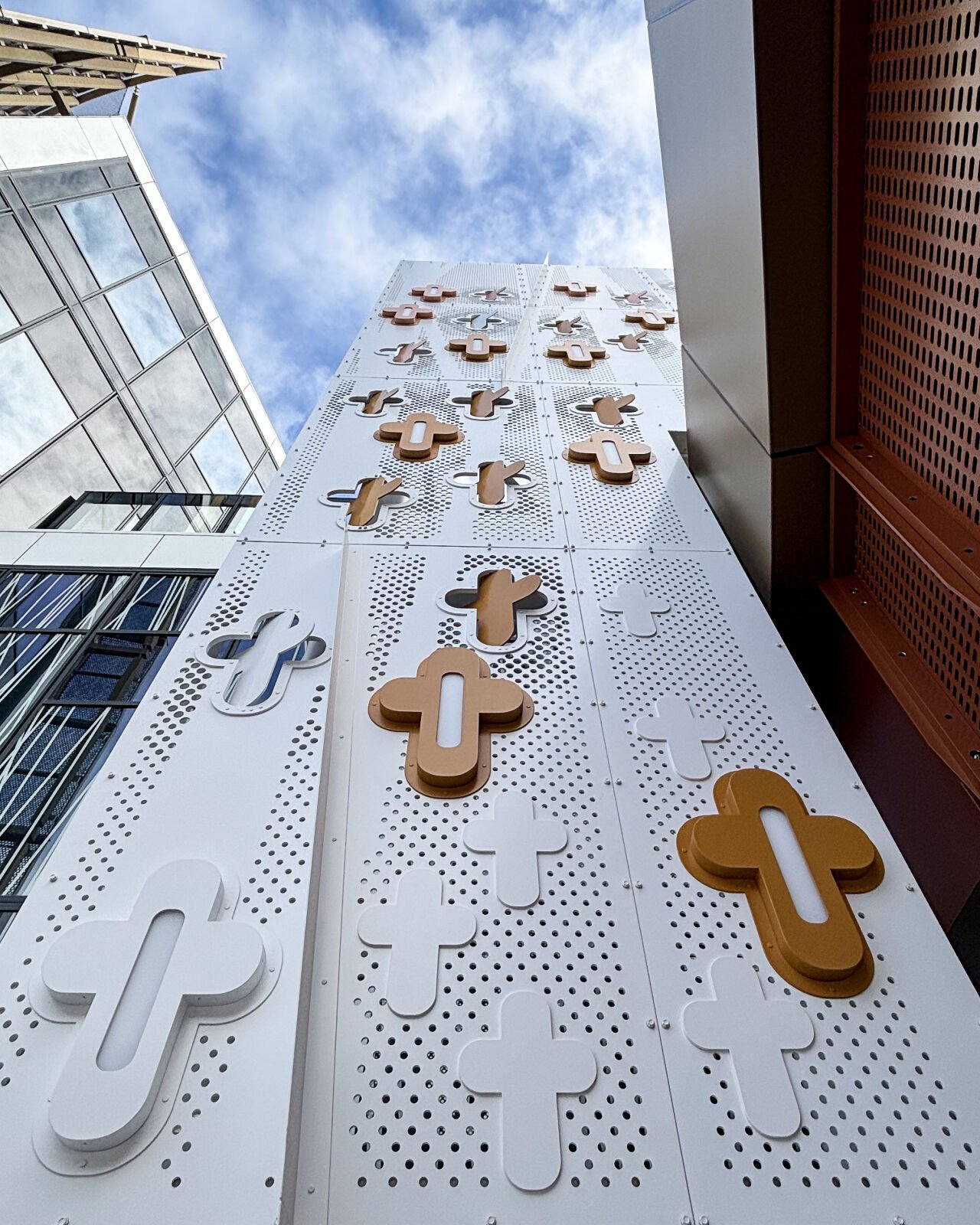
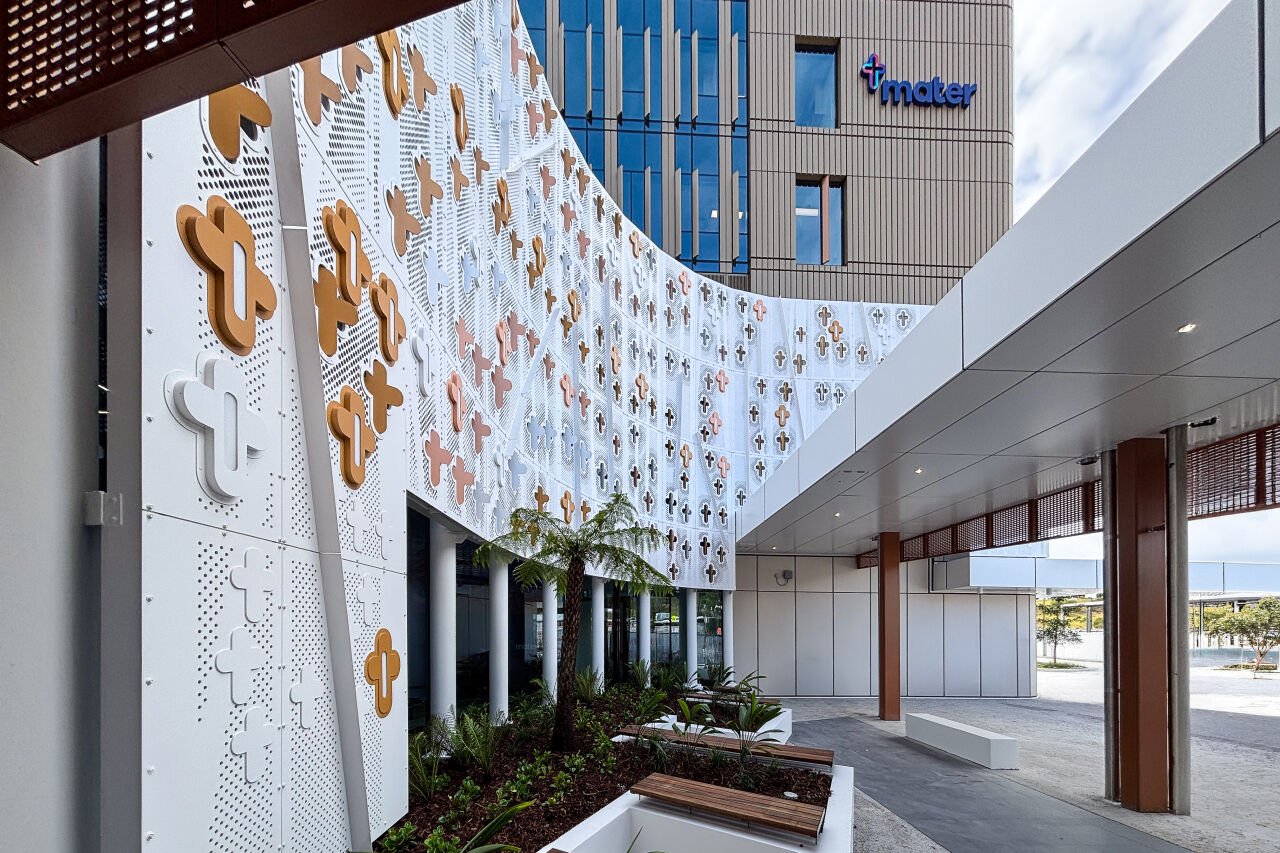
The facade wraps the main hospital entrance in perforated aluminium. Its cross motif design, distributed across a modular panel system at varying scales and angles, carries strong symbolic meaning for the Mater brand.
It also presented real technical challenge: structural loads, perforation variation, lighting and code compliance.
UAP came on board well before fabrication. A technical assist phase brought structural engineering, lighting, prototyping and buildability input into the design process while it was still open to change.
Working closely with Peddle Thorpe, UAP resolved cross-placement rules, wind engineering exclusion zones and panel layouts in coordination with the contractor.
Left to the construction stage, that kind of multi-party alignment typically generates costly variations and program delays.
The result was a meaningful cost reduction, achieved not by stripping back the design, but by finding a smarter delivery path. Design intent was preserved. Delivery risk was cut.
Off-site fabrication as a risk management tool
Central to UAP’s approach is the use of off-site fabrication to achieve streamlined installation as a risk management strategy, not simply a production method.
When complex facade components are resolved, assembled and quality-checked in a controlled factory environment, the variables that create on-site cost and program exposure are eliminated before they arise.
Installation becomes a sequenced logistics exercise. Trade interfaces are simplified. Exposure to weather, access constraints and construction-stage problem-solving are reduced.
On the Mater project, panels arrived on site prefabricated and sequentially packed for efficient installation. The subframe system was engineered to connect cleanly to the primary structure.
Practical considerations, including provisions to prevent bird nesting in the horizontal rail system, were resolved in the design phase, not discovered during defects liability.
This methodology has been proven at significantly greater scale.
For Turbulent Line at Brisbane Domestic Airport, UAP fabricated and coordinated more than 100,000 individual kinetic aluminium panels to create an eight-storey facade that responds to wind.
Factory precision and rigorous sequencing were the only viable path to delivery on a project of that scale.
The facade also delivers practical environmental performance, providing shade and natural ventilation to the car park structure, showing how integrated technical design can serve both aesthetic and functional briefs at once.
Bridging design intent and buildable reality
For architect-led outcomes, the challenge is different, but the discipline is the same: translating a compelling design vision into a system that can be built within budget and without compromise.
At SITE Santa Fe in New Mexico, UAP worked alongside SHoP Architects and the general contractor to develop a cladding system of folded and perforated aluminium panels. The brief required meeting both the design intent and the cost parameters.
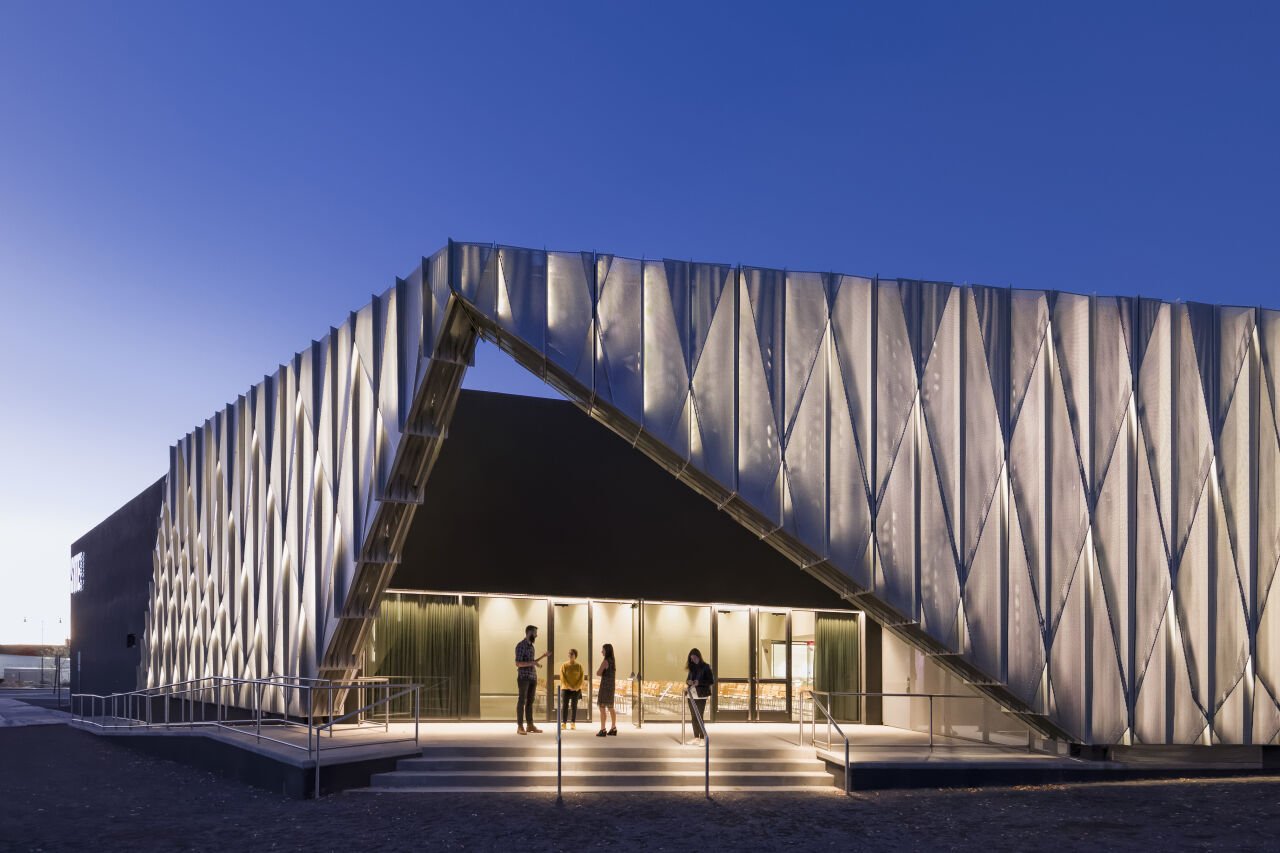
Computational tools managed the complexity of a system made up of many unique components. The result unified the museum’s existing and new buildings with a dynamic, moiré-effect facade that has become its visual signature.
The Fenix Museum of Migration in Rotterdam, completed in 2025, shows just how far specialty architecture can go when a specialist fabricator is embedded in the room from day one.
Designed by MAD Architects on the banks of the River Maas, the museum’s centrepiece is the Tornado: a dramatic double-helix staircase that spirals through the building before extending to a rooftop platform.
Six years in development, the stainless-steel structure comprises tens of thousands of unique components. Its crowning element is a large mirror-polished oval cap engineered and fabricated entirely by UAP’s global partner CIG.
The project shows what is possible when technical skill and fabrication expertise are locked in from the start. Complex geometry was turned into a built reality, piece by piece, with no loss of design intent.
The project has since been shortlisted for the World Architecture Festival Awards.
The value of a single accountable partner
What connects these projects is not a shared material palette or aesthetic. It is a shared model: technical expertise engaged early, fabrication resolved off-site, and end-to-end delivery managed through a single accountable partner.
UAP’s integrated capability spans consultancy, global manufacturing and local project management. The gap between design intent and constructed outcome is closed in the design phase, not discovered on site.
For developers, contractors, and architects managing complex facades, that is what day-one certainty looks like in practice.
#相关文章
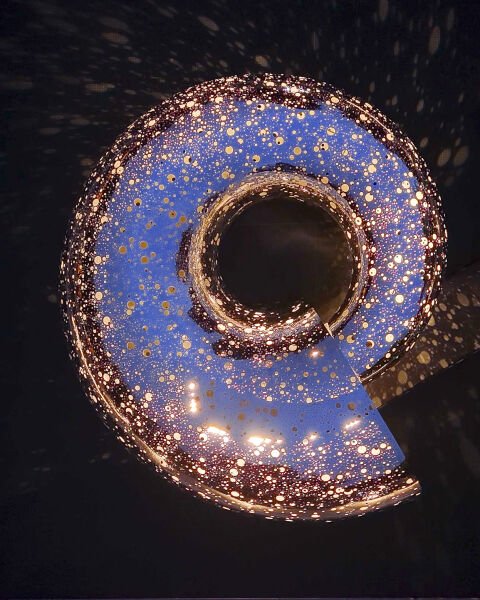
Photographic Journey of Ouroboros
Lindy Lee’s 13-tonne sculpture, Ouroboros, is in place after three years of anticipation.
Contemporary Art, Material Exploration and Transformations
A Look at Tom Keukenmeester's Residency at our Brisbane Workshop
Giles Miller Studio has unveiled a new sensory-inspired sculpture
An article by Architecture Magazine